
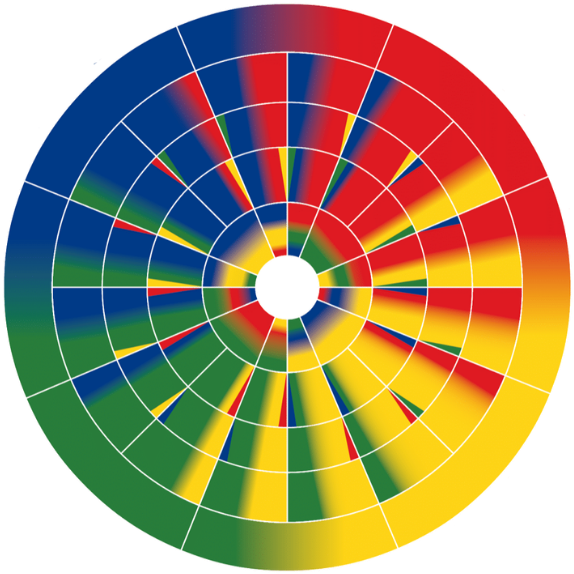
The AECdisc® wheel. Four colours, eight types.
The wheel maps behaviour to four basic colours and the transitions between them. If you know the colour of the person in front of you, you know how to reach them. Six motives add why someone acts the way they do.
Four colours. Four ways of seeing the world.
The wheel shows which colour shapes a person most and how strongly, across five levels of flexibility. That determines how someone communicates, decides and reacts under pressure.
- RedDominance
- Decisive, willing to take risks, goal-oriented, direct. Shows in leadership roles and project management. Under pressure, Red becomes impatient.How to reach Red: briefly, result first, with room to decide.
- YellowInfluence
- Sociable, spontaneous, persuasive, optimistic. Typical in customer contact and communication. Under pressure, Yellow easily overlooks details.How to reach Yellow: personally, focusing on the opportunity, with details in writing afterwards.
- GreenStability
- Friendly, relaxed, warm, willing to compromise. Suits support and team coordination. Sudden changes put strain on Green.How to reach Green: announced early, with reasons and time for questions.
- BlueConformity
- Systematic, precise, evaluative, detail-oriented. Common in roles that demand a high level of accuracy. Blue quickly takes criticism personally.How to reach Blue: with facts, documents in advance and objective criticism.
Opposite colours, such as Red and Green, share no characteristics. In the report this counterpart is called the complementary type, with guidance on how to communicate well anyway. Colour descriptions according to AECdisc®.
Eight types instead of four. For a more precise picture.
Classic DISC models know four basic types. AECdisc® adds the blends in between and places every profile on one of 68 positions. Choose a type in the wheel.
Red/Blue
Organiser
Combines determination with clear structure.
The organiser plans ahead, keeps the result in view and makes sure projects are not only started but consistently completed. They like to take responsibility and give others orientation through reliable processes.
- Organiser
- Red/BlueCombines determination with clear structure. The organiser plans ahead, keeps the result in view and makes sure projects are not only started but consistently completed. They like to take responsibility and give others orientation through reliable processes.
- Initiator
- Red/YellowPrefers acting to waiting. The initiator spots opportunities early, decides quickly and gets stuck situations moving again. They tackle challenges head on, bring pace to the team and do not shy away from uncomfortable decisions when they secure progress.
- Motivator
- Yellow/RedInspires and carries others along. The motivator brings energy to groups, wins people over for shared goals and keeps spirits up even in demanding phases. With a positive, approachable manner they create momentum and turn plans into something many people stand behind.
- Communicator
- Yellow/GreenBuilds bridges between people. The communicator approaches others openly, makes contacts quickly and introduces ideas in a way that lands. They encourage exchange, mediate between different points of view and keep relationships in the team alive.
- Adviser
- Green/YellowCalm support with a clear head. The adviser listens attentively, thinks along and weighs things up carefully before giving advice. They take people and their concerns seriously, create an atmosphere of trust and give the team sound, level-headed orientation.
- Supporter
- Green/BlueThe calm centre of the team. The supporter is reliable, patient and balancing, provides stability and covers for others. You can count on them, especially when things get hectic. Their loyal, helpful manner gives the people around them security and support.
- Coordinator
- Blue/GreenBrings order to the details. The coordinator keeps track of processes, deadlines and specifics and makes sure nothing slips through. They work conscientiously and with foresight, think processes through and turn plans into clean, well-considered execution.
- Analyst
- Blue/RedThe standard for accuracy. The analyst checks thoroughly, questions and thinks in connections instead of judging too quickly. They base decisions on facts, spot errors early and so safeguard the quality and reliability of results.
The wheel shows what is visible. The motives show why.
Six fundamental drivers, independent of the job. Only behaviour and motives together make a genuine personality analysis.
- Cognitive
- Knowledge, insight and understanding connections are the driving force.
- Aesthetic
- Harmony, expression and design are at the centre.
- Economic
- Benefit, efficiency and measurable results count most.
- Social
- Relationships, community and the well-being of others come first.
- Individualistic
- Independence, influence and one's own position are the driving force.
- Traditional
- Values, principles and a larger sense of meaning provide orientation.
From questionnaire to profile.
One online questionnaire, three steps to the profile. What is measured is the individual expression.
Self-assessment
In an online questionnaire, the person chooses which descriptions fit them most and least. This takes about 20 to 25 minutes.
Behaviour is located
The answers determine the position in the AECdisc® wheel, between the basic colours and at the matching one of the eight behaviour types.
Motives added
At the same time, personal drivers are evaluated. This shows not only how someone acts, but also why.
The evaluation is instant and automatic. There is no right or wrong and no good or bad result.
On solid foundations.
Typology of personality.
Four basic dimensions of behaviour.
Six motives that drive human action.
What you will have in your hands.
Over 30 pages, plus the AECdisc® wheel, potential chart and motivation chart.
- Personality & behaviour
- General assessment and behavioural preferences.
- Talents & strengths
- The person's organisational talents and strengths.
- Ideal environment
- The working environment in which the person is most effective.
- Motivation factors
- What motivates professional success.
Where are you on the wheel? Find out.
The first access is free and without obligation. We discuss the results with you personally.


Andreas & Maximilian Mautner
mautner@aec-disc.at